There was a time when choosing an offshore partner was simple: check language proficiency, compare hourly rates, and sign the contract—but the 2026 Infrastructure Report for Southeast Asia highlights why that passive approach no longer works.
By 2026, that honeymoon phase is officially over. In this hyper-demanding era of operational execution, even the most brilliant tech talent or empathetic agents fail if their screens go dark mid-transaction or network latency spikes past a second. Today, enterprise buyers look past basic labor arbitrage, prioritizing utility infrastructure resilience, sub-second network route architectures, and grid redundancy instead.
With workflows relying heavily on cloud data, live analytics, and generative AI, utility instability is a quiet operational killer. For a standard ten-person remote team, minor connectivity lags and power dips cause a subtle 10% to 20% drop in productivity, translating to 2,000 to 4,000 idle hours lost annually.
To protect their standing as global delivery powerhouses, the core markets of Southeast Asia—the Philippines, Vietnam, and Malaysia—are shifting past basic tech upgrades to aggressively re-engineer their physical landscapes.
The Philippine BPO Landscape: Embracing Geospatial Resilience
The Philippine IT-BPM sector remains a vital economic pillar, driving roughly 8% to 9% of national GDP. Scaling from $38 billion in export revenues in 2024, the industry has crossed $42 billion in 2026, employing a workforce of over 2 million professionals. However, concentrating this growth inside Metro Manila choked the capital’s urban core, triggering talent wars, wage inflation, and strained municipal services.
To survive, the industry shifted from Urban Density to a philosophy of Geospatial Resilience. Operators are decentralizing, establishing fully functional hubs across secondary and tertiary provincial centers designated under the government’s Digital Cities program.
The Philippines Hub and Spoke Distribution
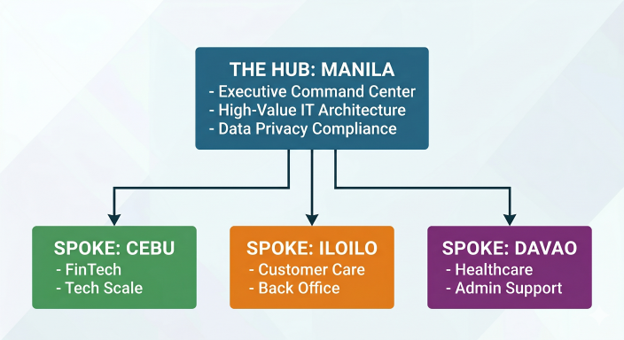
Cities like Iloilo, Cebu, and Davao are now primary, high-performance delivery engines. They offer a 15% to 20% reduction in operational overhead and attrition rates that sit 18% to 22% lower than Manila’s high-turnover environment. This boom is fueled by a powerful Reverse Migration trend. Thousands of battle-tested BPO managers and technical directors are leaving Manila’s traffic behind to head home for a better quality of life, allowing international buyers to source top-tier, Manila-trained leadership at regional cost structures.
By adopting this Hub-and-Spoke model, Metro Manila acts as the strategic command center while regional spokes run day-to-day delivery. If a severe typhoon or localized grid failure cuts power in the capital, workloads are seamlessly rerouted to the spokes instantly. A multi-hub setup is now a standard requirement to close enterprise deals.
Philippine Regional Hub Comparison
- Metro Manila: Focuses on Executive Management, Advanced IT, GenAI Architecture, and Content Strategy. It serves as the baseline cost structure with the deepest talent pool, primary headquarters, and direct fiber links.
- Metro Cebu: Tailored for FinTech Development, Technical Support, and Health Information. Offers a 10% lower operational cost and 15% lower turnover, backed by PEZA-accredited IT parks.
- Iloilo City: Aligned with Customer Care, Multi-Channel Support, and Voice Operations. Delivers a 20% lower cost and 25% lower turnout, powered by high English proficiency and proactive governance.
- Davao City: Focuses on Healthcare Documentation, Back-Office Administration, and Data Processing. Offers 15% lower costs, 20% lower turnout, and an academic pipeline from over 45 regional universities.
- Bacolod City: Specializes in Finance and Accounting, Back-Office Support, and Insurance KPO. Features 22% lower costs, a 30% reduction in turnout, and high accounting graduate loyalty.
- Clark / Angeles: Structured for Logistics BPO, Multi-Language Tech Support, and Procurement. Provides a 5% cost advantage and 12% lower turnout due to its proximity to Clark International Airport.
Grid Stress, Smart Coworking, and the LEO Satellite Safety Net
Despite provincial expansion, Manila remains the main brain for complex IT architecture and financial analytics. Yet, the capital’s aging energy grid experiences frequent stress. Regular distribution maintenance and sudden power plant failures cause daytime brownouts lasting four to eight hours, stalling local transit and testing operational patience.
To avoid building heavy infrastructure on-site, smart operators are moving teams into premium plug-and-play coworking spaces in business districts like BGC, Makati, and Ortigas. These spaces are built out with redundant multi-carrier fiber lines and immediate auto-switch backup generators, allowing modular scaling without dedicated real estate liabilities.
Simultaneously, the permanent shift toward hybrid and work-from-home (WFH) models has pushed infrastructure risks straight onto individual employees. In a residential setting, a brief power flicker or a severed fiber line drops an agent instantly, breaking strict service SLAs.
To fight this, remote professionals utilize localized redundancy setups: small uninterruptible power supplies (UPS) or lithium battery stations (like Bluetti or Jackery) paired with Low-Earth-Orbit (LEO) satellite broadband.

Across the Philippine archipelago, Starlink has become the ultimate insurance policy. By pointing directly to the sky, it bypasses vulnerable ground infrastructure—like downed towers or severed cables—keeping teams online through the worst typhoons. Local distributors like Data Lake and networks like Ardent package this into corporate offerings, delivering reliable 80 to 350 Mbps downlinks with 24/7 technical support.
To maintain tight enterprise compliance, network administrators build a structured network architecture behind the terminal:
- Direct WAN Transport: The terminal serves strictly as a high-speed transport layer, using laser links to route traffic to the nearest domestic ground station.
- Enterprise Router Integration: A dedicated hardware firewall and router manage DHCP, internal routing, and corporate security policies.
- VLAN Segmentation: Voice channels and administrative data are split into separate virtual networks to prevent data bleed and maintain compliance.
- QoS Traffic Shaping: Bandwidth rules prioritize crystal-clear client voice and video streams over background applications.
- Outbound VPN Tunnels: Systems utilize outbound-initiated tunnels, allowing the core corporate network to monitor remote devices without exposing open ports to the public internet.
Vietnam: Navigating the Dry-Season Squeeze with On-Site Battery Tech
Vietnam has become a premier destination for software engineering and technical outsourcing, offering a highly driven pool of STEM graduates at rates 30% to 70% cheaper than Western markets. Backed by proactive government policies and tech tax breaks, Vietnam’s IT outsourcing footprint is on track to double by 2028. However, running a high-growth tech operation here means keeping up with tight compliance—like Decree 13’s local data storage requirements—while navigating an electricity grid under intense pressure.

The real test happens during the dry season (April to July), when heat spikes drive up demand while water levels plunge at critical northern hydroelectric plants. Vietnam Electricity (EVN) is pushing to grow generation by 15% in 2026 to support advanced semiconductor fabrication and AI data centers. Yet, during intense dry spells, peak demand can surge by 14.1%, forcing the state utility to initiate energy conservation protocols to avoid unexpected blackouts. Compounding this is a green paradox: Vietnam added over 18 GW of solar energy rapidly, causing huge midday power surpluses followed by steep evening shortages, leading to solar grid curtailment rates of up to 20%.
To safeguard their workflows, advanced tech parks are installing private Battery Energy Storage Systems (BESS). While regional operational battery capacity sits at 1.4 GW, scaling it nationwide remains slow due to weak utility-scale price signals. Consequently, deployment has shifted directly to private Commercial and Industrial (C&I) installations.
Thanks to Decree 57, developers can install a private-wire framework, bypassing the national grid completely. Operators can run direct transmission lines from nearby renewable setups right into their parks. When hooked up to Lithium Iron Phosphate (LFP) battery systems, these microgrids insulate businesses from municipal power sags.
Energy Sourcing Architecture Comparison
- Standard National Grid Connection: Vulnerable to dry-season outages and voltage fluctuations. Features no upfront infrastructure costs, but is subject to variable peak pricing and regional demand-response mandates.
- Private-Wire + LFP BESS (Decree 57): Delivers 99.99% uptime with millisecond response to grid sags. Requires a turnkey expenditure of $200–$300 per kWh for a 1 MW/2 MWh installation, hitting full capital payback in 3.5 to 4 years while meeting green compliance mandates.
The deployment of industrial-grade BESS yields clear operational benefits for tech parks:
- Power Quality and Uptime: Industrial LFP batteries track grid frequency in real-time, discharging in milliseconds during a voltage drop to shield delicate databases from resetting.
- Scrap and Defect Reduction: In precision manufacturing, a microsecond power drop can glitch automated lines. Integrating a ride-through BESS can slash these defects by 30%, saving millions in potential lost output.
- Shared Infrastructure Savings: A centralized, substation-level BESS protects multiple software development, back-office, and customer service facilities simultaneously, distributing the capital cost across tenants.
- Local Logistics: The buildout is supported by a solid domestic supply chain, with major regional plants like Fluence’s 35 GWh/year facility in Bac Giang making maintenance and parts replacement simple.
Malaysia: Building the Intelligent AI Backbone of ASEAN
While the Philippines masters customer care and Vietnam codes agile software pipelines, Malaysia has engineered itself into the heavy computing engine of Southeast Asia. Moving under a national policy pivot known as Data Centre 2.0, the country has evolved from housing basic, passive data storage to establishing ecosystems optimized for high-performance computing and generative AI.
The numbers behind this transition are staggering. According to historical investment logs from the Malaysian Investment Development Authority (MIDA), the agency approved RM144.4 billion in data center and cloud projects between 2021 and mid-2025. In the first nine months of 2025 alone, the country secured RM285.2 billion in approved investments, with RM85.4 billion funneled specifically into high-end data infrastructure. Tech leaders—including Microsoft, Amazon, Google, NVIDIA, Oracle, and ByteDance—have injected over $16 billion into the country, centering a massive chunk of this capacity in Johor. Microsoft rolled out its first local cloud region, and AirTrunk launched its AI-ready JHB1 facility in Johor, scaling capacity beyond 420 MW.
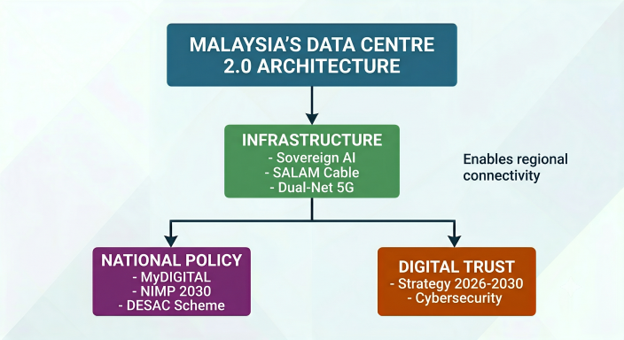
This structural boom is guided by an organized web of national policy frameworks, including the MyDIGITAL blueprint, the New Industrial Master Plan 2030 (NIMP 2030), and targeted funding under Budget 2026. The core pillars include:
- Sovereign AI Cloud: National infrastructure built to support data sovereignty and provide secure computing capacity for public and private sectors.
- The SALAM Submarine Cable: A major underwater cable network engineered to scale international bandwidth, eliminate latency, and expand network redundancy.
- Digital Trust & Data Security Strategy 2026-2030: A comprehensive regulatory framework designed to harden cybersecurity standards, lock down user data, and protect enterprise assets.
- The DESAC Scheme: A government program offering investment tax allowances and special tax rates to attract high-value digital operations.
- Data Centre Nexus: A supply-chain integration initiative connecting global operators with elite local precision engineering and electrical systems vendors to speed up delivery.
To guarantee fast, low-latency connectivity, Malaysia deployed its 5G network using a competitive dual-network model. The primary network covers 82.4% of populated zones, while the secondary network, operated by UMobile, achieved 57% coverage within its opening months. With over 60% of mobile accounts actively using 5G, Malaysia has built one of the most well-connected digital societies in the region at incredibly competitive rates.
This deep infrastructure has also unlocked incredible cross-border synergy. The Johor-Singapore Special Economic Zone (JS-SEZ) leverages Singapore’s tight land and power limits by turning Johor into the natural destination for hyperscale overflow projects. This economic bridge is about to get a massive boost with the Johor Bahru-Singapore Rapid Transit System (RTS Link), set to open in January 2027. It will move technical professionals across the border in minutes, creating a seamless, dual-hub digital economy.
Sourcing Rules for Modern Buyers
For risk officers and procurement teams looking at outsourceasia.org to design their delivery networks, the 2026 landscape requires a modern, portfolio-based approach to location selection. Relying on a single city, provider, or utility grid is a massive operational gamble. To build a resilient footprint, organize your strategy around three core rules:
- Route the Right Work to the Right Infrastructure
Match the technical needs of your project to the local infrastructure strengths of each market. Put high-volume customer care, multi-channel voice programs, and back-office pipelines into provincial Philippine cities like Iloilo, Bacolod, or Cebu, where talent pools are stable and fiber lines are proven. Send complex software development, engineering tasks, and DevOps to Vietnam’s rising tech parks—making sure those facilities run direct microgrids or on-site BESS backups. Keep your heavy data analytics, enterprise cloud applications, and AI model workflows inside Malaysia’s elite data hubs, which are legally protected and structurally built for high-performance computing.
- Turn Infrastructure RedundancyIntoa Binding SLA
Stop accepting boilerplate disaster recovery clauses. Sourcing contracts must explicitly state that vendors maintain a minimum of 72 hours of live, automated backup power on-site, secured by guaranteed fuel supply agreements. If you run hybrid or work-from-home teams, write strict connectivity baselines directly into your contract. Require your partners to supply agents with portable power stations and secondary LEO satellite connections to completely bypass neighborhood grid failures.
- Diversify Your Footprint via Hub-and-Spoke
The days of putting all your operational assets in a single metropolitan basket are over. Run a diversified strategy. Keep your strategic executive command center and security architecture in a mature capital city, but push specialized execution out to distinct regional spokes. This multi-site approach ensures that if a severe weather event, a localized blackout, or a major subsea fiber break hits one hub, your operational traffic can be rerouted to another spoke in real-time, keeping your business running without missing a beat.
The Bottom Line
The Southeast Asian outsourcing market is no longer a race to the bottom on labor costs; it is a race to the top on structural resilience. As the region solidifies its status as a global delivery powerhouse, the dividing line between operational success and catastrophic downtime comes down to the physical foundations beneath the talent.
For enterprise buyers and sourcing executives, navigating this landscape requires shifting from passive procurement to active infrastructure auditing. By matching service tiers to localized market strengths, embedding strict utility redundancy into contractual vendor SLAs, and executing a geographically diversified hub-and-spoke footprint, organizations can fully insulate their operations from localized volatility. Talent may capture the initial investment, but infrastructure resilience is what sustains long-term enterprise value.
Outsource Asia can connect you with an experienced, specialized partner who fits your exact needs. Let us help you build a team that makes your business better every day.
Contact us today to get started.