The global tech landscape has officially moved past the era of cheap, purely transactional outsourcing. If recent industry shifts—like those highlighted at the Chicago Outsourcing World Summit—tell us anything, it’s that modern enterprises are abandoning simple labor arbitrage. Instead, they are chasing long-term strategic value, serious technical depth, and operational agility.
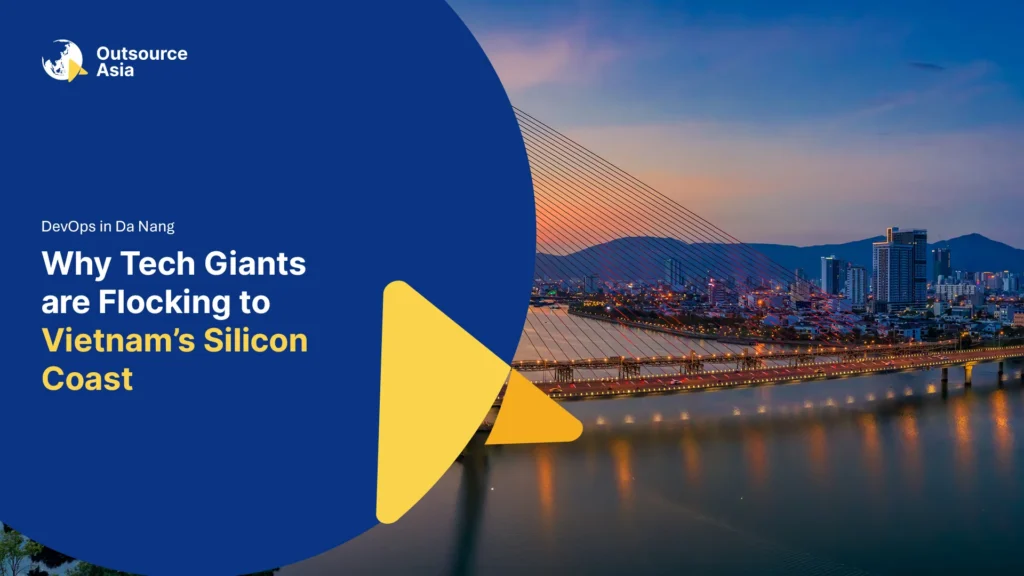
In this new climate of strategic realignment, Vietnam is no longer just a backdrop for basic QA testing or legacy migrations. It has rapidly evolved into a prime destination for complex software engineering, cloud-native architectures, and highly automated infrastructure operations. At the heart of this national transformation sits Da Nang, a vibrant coastal city earning a reputation as Southeast Asia’s “Silicon Coast.”
Driven by aggressive municipal backing, proactive localized university partnerships, and sweeping infrastructure upgrades, Da Nang is quickly becoming an indispensable node for global technology leaders. For engineering teams, the city provides a highly resilient, modern environment capable of running continuous integration and continuous delivery (CI/CD) pipelines, deploying elastic cloud environments, and executing fast-paced agile development at scale.
The Macroeconomic Arbitrage: Tier-2 Advantages Over Tier-1 Congestion
Western tech hubs are facing structural talent crunches alongside stubbornly high wage inflation. Finding mid-level DevOps or cloud engineers in the US or Western Europe often means stomaching contract rates between $110 and $150+ per hour.
By contrast, Vietnam offers a highly compelling financial alternative without asking companies to compromise on engineering rigor. Hourly development rates in Da Nang across specialized technical tracks typically float between $20 and $40. That represents a near 90% reduction in upfront operational costs compared to Western markets, and a significant 30% to 40% savings relative to aging regional tech capitals like Bangalore or Shanghai.
While Ho Chi Minh City and Hanoi have traditionally served as the two main pillars of Vietnam’s IT sector, Da Nang offers a distinct “Tier-2” advantage. By establishing footprints here, enterprises can sidestep the saturated, cutthroat, and high-turnover talent pools of the larger metropolises while capitalizing on lower local real estate costs and minimized operational overhead.
| Market | Position & Strategy | Talent Pool & Stability | Average Hourly Rates | Core Ecosystem Characteristics |
| Ho Chi Minh City | Largest commercial hub | Deepest pool, but suffers from high attrition | $35 – $70 / hour | Intensely competitive; corporate and commercial focus. |
| Hanoi | Political capital & research hub | Academic and research-oriented base | $30 – $60 / hour | Strong ties to state enterprises and deep engineering universities. |
| Da Nang | Emerging growth hub (“Silicon Coast”) | Highly stable, rapidly expanding | $18 – $48 / hour | High community collaboration, lower attrition, heavy municipal backing. |
One of Da Nang’s biggest competitive weapons is talent stability. Local offshore engineering partnerships boast an average retention rate of roughly 94%. This operational continuity is a massive relief for project managers, as it virtually eliminates the constant onboarding friction and retraining costs common in volatile developer markets.
This talent base isn’t just growing in numbers; it’s maturing in capability. A robust network of domestic software firms has anchored the city’s technical foundation. Firms like Enouvo IT Solutions regularly deliver agile-driven systems built on ASP.NET, Node.js, and React. Meanwhile, mid-sized engineering houses like SmartDev LLC (part of the Swiss Verysell Group) and Enlab Software focus heavily on long-term digital transformation and heavy-duty platform engineering for international client portfolios.
Physical and Digital Infrastructure: Built-in Redundancy Under the Sea
A tech hub is only as good as its uptime. Da Nang’s physical and digital backbones have been systematically overhauled to handle the massive data throughput required by enterprise cloud infrastructure.
A major anchor of this effort is the newly completed Da Nang Software Park No. 2 in the Hai Chau District. Built with an initial public injection of VND 986 billion and reinforced by an additional VND 414 billion, the total capital investment crossed VND 1.4 trillion (roughly $60 million).
Spanning more than 28,600 square meters, the facility features a landmark 20-story ICT Tower alongside two 8-story corporate blocks. The campus is built to house over 6,000 advanced engineers and dedicated R&D units. It marks the city’s fourth centralized IT zone, feeding into a broader metropolitan tech ecosystem that currently employs over 53,000 digital professionals.
To keep these zones insulated from outages, local infrastructure providers are embedding deep physical network redundancies:
- Subsea Connectivity: The Asia Pacific Gateway (APG) submarine fiber-optic cable lands directly on Da Nang’s coast, tying the city to major internet exchanges across Asia with ultra-low latency.
- Next-Gen Cable Landing Stations: To expand bandwidth, FPT Telecom and Viettel are co-developing a state-of-the-art landing hub in the Ngu Hanh Son Ward for the Asia Link Cable (ALC). Packing a massive 18,000 Gbps total capacity, this link guarantees high-speed paths to major markets like Singapore, Hong Kong, and Japan by late 2026.
- Local Hyperscale Compute: Viettel recently broke ground on a 14-megawatt, Tier 3-certified data center within the Hoa Khanh Industrial Park. As the largest high-performance computing facility in Central Vietnam, it provides the massive virtualization, storage, and container orchestration capabilities required to run distributed enterprise workloads and automated code pipelines securely.
Corporate R&D and High-Tech Anchors
The operational readiness of Da Nang is no longer theoretical. Multinational corporations are actively embedding local engineering squads into their core global IP production lines.
LG Electronics Vietnam R&D
LG Electronics runs a major Research and Development subsidiary in Vietnam employing over 1,250 software engineers. While Hanoi holds the largest footprint, roughly 400 specialized engineers are permanently stationed in Da Nang. This central coast team is explicitly tasked with designing, verifying, and testing core automotive systems, including telematics software, in-vehicle infotainment (IVI) systems, and digital clusters for premium global automakers.
Ubisoft Da Nang
Established in 2020 as Ubisoft’s standalone studio in Vietnam, this group has become a critical link in the gaming giant’s global co-development engine. Their portfolio stretches from premium mobile development to AAA contributions for iconic IPs like Assassin’s Creed and Prince of Persia.
To maintain aggressive release schedules across global teams, the Da Nang engineering crew built a proprietary internal toolchain called the Nano Game Core (NGC). Engineered with HTML5, the NGC acts as a modular framework that automates feature delivery while allowing designers to tweak gameplay mechanics and balance parameters in real time—entirely bypassing the need to trigger heavy, multi-hour software rebuilds.
Marvell Technology & FPT Corporation
The city’s silicon ambitions received a major boost with the arrival of US semiconductor giant Marvell Technology. Setting up its Da Nang office inside Software Park No. 2, Marvell works closely with the local Da Nang Semiconductor and Artificial Intelligence Center for Research and Training (DSAC) to build localized engineering talent pipelines. Concurrently, domestic tech giant FPT Corporation opened its own 3,000-square-meter Semiconductor R&D Center in the same park, creating room for 500 specialists focused on designing custom silicon and “Make in Vietnam” microarchitecture software.
Community Maturation and DevSecOps Integration
A truly resilient technical ecosystem requires an organic culture of continuous learning and peer review. Da Nang’s developer community has achieved significant maturity, moving beyond passive online forums to establish structured user groups and major technical conferences.
Grassroots organizations like GDG Cloud Da Nang regularly host hands-on boot camps and workshops covering Kubernetes multi-tenancy, machine learning loops, and container security. Similarly, initiatives like the Da Nang Cloud Talk series—co-engineered by SupremeTech and the AWS Community Vietnam—bring together technical architects from AWS, Cloudflare, and regional enterprises. These sessions focus on solving practical engineering bottlenecks, such as zero-trust perimeter configurations, complex database migrations, and the deployment of compliance guardrails directly inside CI/CD loops.
This rapid skill acquisition is fed directly by a thick local academic ecosystem. Da Nang boasts over 20 universities and technical colleges focused on computer science and software engineering. Top schools like the University of Da Nang, FPT University, and the Vietnam-Korea University of Information and Communication Technology (VKU) build their curriculums directly alongside enterprise tech partners. As a result, graduates hit the market with direct, production-level exposure to cloud platforms, infrastructure-as-code (IaC) principles, and container networking.
Navigating a Strict Regulatory Landscape
As Da Nang’s tech footprint expands globally, local engineering squads have adapted to a tightening regulatory landscape. The enforcement of Decree 13 on Personal Data Protection has completely changed how companies handle, process, and store user data within Vietnam.
Because Decree 13 mandates absolute data traceability and strict audit trails, the traditional DevOps role has transformed. It is no longer just about optimizing server density or deployment speed; it is now a fundamental shield for compliance and risk management. Platforms built on the Silicon Coast are systematically embedding security guardrails directly into the software development life cycle (SDLC) using a strict DevSecOps approach:
- Infrastructure as Code (IaC) Sanitization: Platform engineers use tools like Terraform or AWS CloudFormation to programmatically define compliant network perimeters. This ensures that every subnet, database instance, and storage bucket automatically conforms to data sovereignty standards before a single line of application code runs.
- Continuous Security Vulnerability Profiling: Automated static and dynamic testing engines (SAST and DAST) are integrated right into the source code pipeline, scanning for misconfigured containers, unpatched third-party dependencies, or accidental hardcoded secrets in real time.
- Identity and Access Governance: Security teams enforce strict least-privilege access models, utilizing automated short-lived token management systems to secure machine-to-machine interactions across hybrid-cloud environments.
- Continuous Compliance Auditing: Site Reliability Engineering (SRE) teams deploy comprehensive logging, real-time metric aggregations, and alerting frameworks. This setup gives compliance officers instantaneous visibility into infrastructure changes, flag-dropping anomalies, or potential data policy violations.
This hard shift toward automated validation matches broader industry patterns. As noted in Outsource Asia’s recent industry updates, while automated engines can flag high-volume system telemetry, human expertise remains irreplaceable for sniffing out sophisticated, non-deterministic threats like prompt manipulation or memory exploitation. Da Nang’s engineering groups bridge this gap by keeping tight feedback loops between automated tools and seasoned security engineers, ensuring software remains robust against both regulatory changes and modern threat vectors.
Looking Ahead: The Silicon Coast’s Strategic Horizon
Da Nang’s transition into a high-tier global engineering destination is the result of a deliberate convergence: targeted municipal funding, hardened infrastructure redundancy, and a stable, highly adaptive technical workforce.
Under the city’s Master Plan 2030, local authorities aim to have the digital sector drive more than 35% of the regional GDP. Backed by the massive capacity of Software Park No. 2, direct subsea connectivity via the ALC, and enterprise-grade data centers, the city provides a highly reliable foundation for execution.
As international enterprises struggle to balance rapid feature deployment with strict cost control, Da Nang offers a rare sweet spot. By embedding local platform engineering and DevOps specialists into their development pipelines, global businesses can scale their infrastructure safely, maintain uncompromising regulatory compliance, and build sustainable technical assets along Vietnam’s rising Silicon Coast.
Outsource Asia can connect you with an experienced, specialized partner who fits your exact needs. Let us help you build a team that makes your business better every day.
Contact us today to get started.