For decades, the business process outsourcing (BPO) model was simple: scale human headcounts in offshore hubs to handle repetitive calls at the lowest possible cost. But generative AI has shattered that premise. Today, autonomous agents resolve up to 80% of routine customer requests, password resets, shipping updates, balance checks, instantly and for pennies.
What happens to the remaining 20%?
Those interactions land in human hands precisely because they are messy, emotional, and high-stakes. A canceled flight during a family emergency, a frozen bank account, an unresolved medical claim—these aren’t problems solved by deterministic logic. Worse, when raw AI systems attempt to handle these distress signals, they fall into the trap of “synthetic empathy.” They offer performative apologies (“I understand your frustration”) without fixing the root cause, alienating users and degrading brand trust.
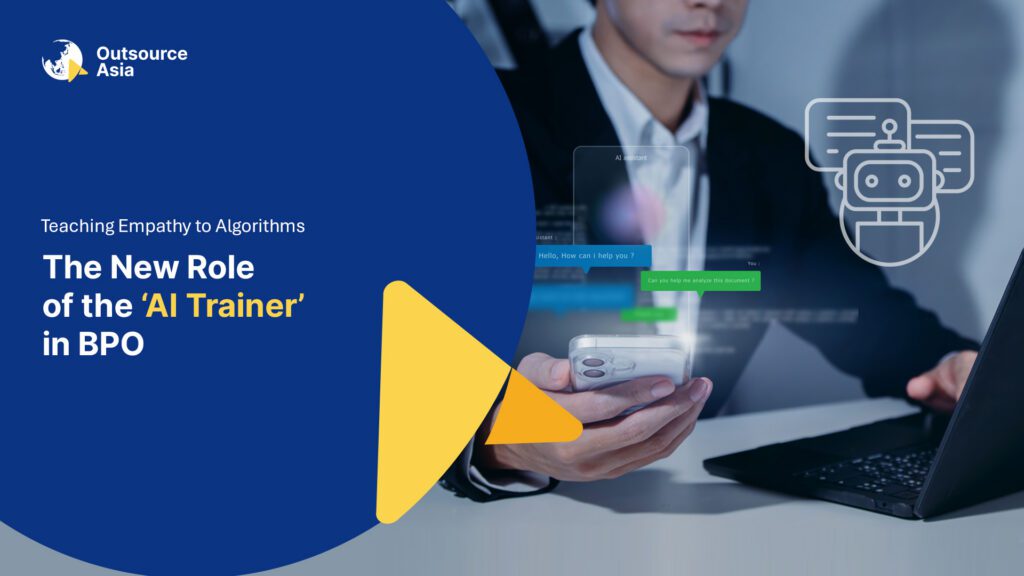
To fix this affective deficit, the industry is pivoting toward “BPO 3.0.” Frontline customer service agents are no longer just answering tickets; they are stepping into a vital new role: the AI Trainer.
From Script Readers to Cognitive Curators
AI Trainers bridge the gap between statistical pattern-matching and authentic human emotion. Rather than letting models drift into sycophancy or hallucinate policy exceptions under multi-turn stress, these specialists curate the behavioral guardrails of enterprise language models.
Supervised Fine-Tuning (SFT): Trainers build dynamic dialogue maps, teaching algorithms tone, ownership language, and the exact threshold where an automated system should stop talking and escalate to a human.
RLHF & Preference Scoring: Using Reinforcement Learning from Human Feedback, trainers evaluate model outputs, penalizing superficial platitudes and rewarding concise, de-escalating resolutions.
Edge-Case Forensics: Trainers act as adversarial red-teamers, pressure-testing systems against irrational or furious prompts to prevent unauthorized concessions and compliance leaks.
The Rise of Specialized Empathy Hubs
This shift is fundamentally altering the outsourcing map. While basic data annotation can be commoditized anywhere, high-order emotional calibration requires genuine cultural intuition and deep domain expertise.
The Philippines, long the global voice capital of customer support, is leading this cognitive layer. Drawing on an innate service culture rooted in malasakit—genuine care for others—local teams are teaching bots how to de-escalate customer tension naturally. In specialized delivery hubs like Iloilo City, talent pipelines of allied health graduates train clinical triage bots, while hubs in Cebu handle complex FinTech compliance workflows.
Replacing SLAs with Experience Outcomes
Because software handles volume and speed, legacy metrics like Average Handle Time (AHT) are obsolete. BPO 3.0 operations live by Experience Level Agreements (XLAs). Success is judged by Time-to-De-escalation, drift reduction, and sentiment trajectory across a conversation.
Coupled with new mandates like the EU AI Act, which enforces transparency around automated interactions and emotion tracking, enterprise procurement must mature. Moving beyond seat-leasing models toward capability-based partners isn’t just about operational efficiency; it’s about brand preservation.
Algorithms can deliver immediate scale, but they don’t possess conscience or care. By placing experienced customer advocates at the center of the machine learning loop, businesses aren’t automating empathy away, they are finally teaching software how to listen.
Outsource Asia can connect you with an experienced, specialized partner who fits your exact needs. Let us help you build a team that makes your business better every day.
Contact us today to get started.